
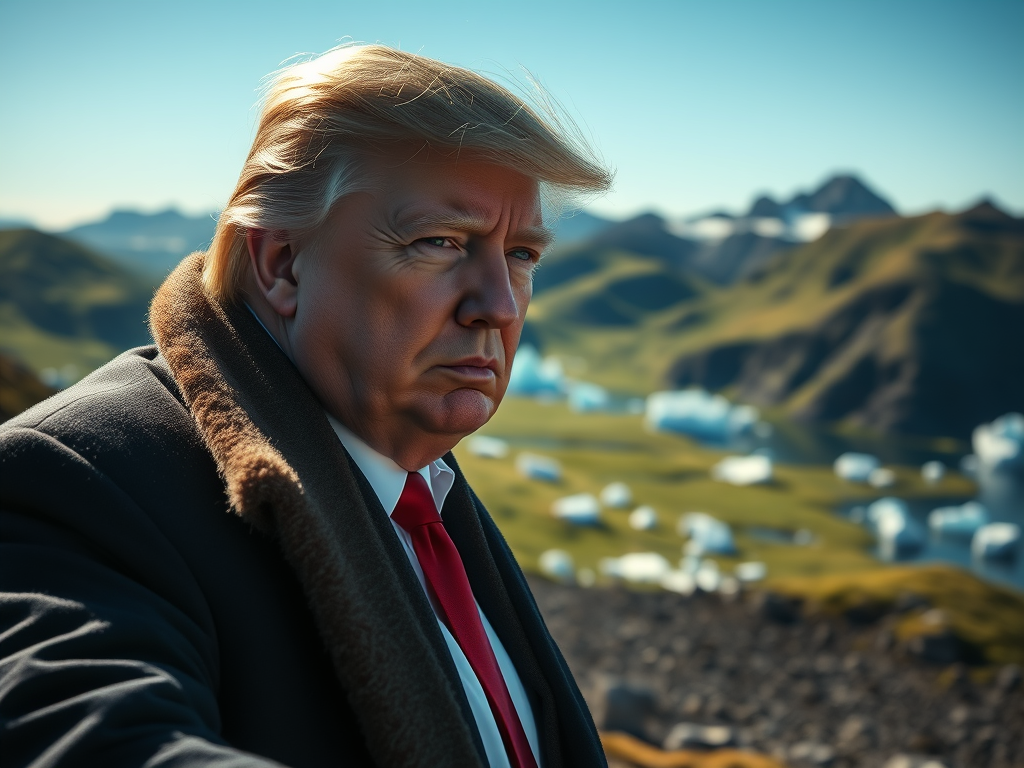
During his first term, while addressing a reporter on Air Force One, Donald J. Trump sowed the seeds for his current agenda by stating that he envisioned America “having” Greenland and that the residents of Greenland wanted “to be with us [the U.S.].” What had previously hampered Trump from acting on his imperialist agenda was Denmark’s out-right refusal of his proposal: “Greenland is ours,” retorted Prime Minister Mette Frederiksen. However, once getting elected to his second term, his rhetoric has gotten increasingly frenetic, stating his intent on taking Greenland by any means necessary. What had once seemed like an absurd business mogul fantasy has bloomed into a dangerous initiative. If Trump’s vision remains unchanged, it has the potential to disrupt not only Greenland’s autonomous rule, but also to shake the very fabric of the Arctic Council, the repercussions of which will impact the already strained geopolitical reality of the world.
While Greenland may be an easily overlooked floating piece of ice, it is actually indispensable when it comes to U.S. military endeavors and national security. Two of the United States’ most prominent rivals – Russia and China – have a military presence in the Arctic region. Amongst the two, Russia has the largest military influence, seeing that almost a quarter of their landmass is located in the Arctic. They have established and modernized a considerable amount of bases with active personnel equipped with nuclear weaponry. Comparatively, China has a smaller yet noteworthy presence in the region. China has integrated the Arctic into their Belt and Road Initiative with the intention of deepening China’s economic influence in the region. To counter China and Russia’s escapades, the U.S. has also maintained a military presence in the Arctic. The U.S. has several military bases along the Northern coast of Greenland, providing key strategic vantage points to monitor Russia and China. It is imperative that the U.S. maintains its presence in the Arctic as it is set to become the new frontier for economic expansion. Scientists project that the Arctic will be ice-free by the year 2040, opening new trade opportunities for nations to exploit the region’s wealth of natural resources. In this critical time, the U.S. should serve as a helping hand for Greenland in order to prevent the growing climate impacts and to maintain the political status quo. However, President Trump has decided to take a different course of action: a decision that could prove momentous.
Trump’s obsession with Greenland is threatening to sour relations with some of the United States’ key allies, pertaining to the Arctic, and undermine our nation’s global perception. Greenland is an autonomous nation with its own parliament under the Kingdom of Denmark. Trump’s disregard for Greenland’s self-determination and Denmark’s sovereignty brings questions about Trump’s adherence to America’s principles. As a result, our allies will never see the United States in the same manner again. Moreover, it sets a dangerous precedent that a more powerful nation has it within their purview to disregard international law and territorial boundaries that have been established since WWII. Trump’s intention to acquire Greenland encourages authoritarian nations to flout international norms, inciting further chaos across the world.
Trump’s persistent attempts to acquire Greenland impacts the whole region’s stability. Composed of eight nations including the United States, Canada, Denmark, and Russia, the Arctic Council has been responsible for keeping peace in the region for nearly three decades. This council tackles issues pertaining to climate change, indigenous rights, and environmental conservation. The U.S. pursuit of Greenland threatens the sustainability and effectiveness of the council. Trump’s unilateral interest in acquiring Greenland could fracture the long-time relationships of some of the nations in the council. Relations with Denmark and its fellow nordic nations would undoubtedly be weakened if Trump were to follow through with his ambition. The United States’ relationship with Canada would be strained as well, seeing that Canada has long maintained the belief in Greenland’s autonomy. Most fragile, however, is Russia’s relationship with the U.S. as Trump’s annexation of Greenland would be a direct challenge to Russia’s stake in the region. The Arctic Council, once a model of cooperation, is now under threat because of Trump’s reckless foreign initiatives. The instability could reach the point where the council may be forced to disband. The fallout of such a dissolution could be history-altering, considering the large military presence opposing factions have in the region.
The impact of Trump’s actions extend beyond the Arctic, as the potential global economic repercussions could be vast. When Russia disregarded Crimea’s self-determination by militarily occupying the region, the United States, the European Union (EU), and other allies sanctioned Russia, crippling Russia’s economy. In fact, Russia’s finance minister at the time estimated that the annexation of Crimea cost the nation 140 billion dollars. If the United States were to engage in a similar effort to forcibly annex Greenland, it’s likely that our allies, namely the EU and NATO, would retaliate with similar economic sanctions and tariffs. This would unquestionably harm the U.S. economy. The EU and NATO are some of the United State’s largest trading partners. Consequently, American industry would suffer and consumers would face the brunt of this economic fallout with exorbitant prices and a shallow job market. As the epicenter of the free world, the failure of the U.S. economy would destabilize global markets, compromising the economies of many nations. Ironically, the man who was elected to office to strengthen the U.S. economy could be the main culprit in the collapse of worldwide markets, impacting innocent citizens across the globe.
Trump’s imprudent decision is bound to have both immediate and long-term consequences for the environment. The Arctic is home to over 5,000 distinct species and tens of endangered populations. These animals are tailored to inhabit cold, icy regions. However, Trump’s plan to extract natural resources and minerals from Greenland will exacerbate global warming, leading to the extinction or displacement of many irreplaceable species. The Arctic possesses around 13% of the world’s undiscovered oil and 30% of the world’s natural gas reserves. Trump intends to exploit these reserves to expand the U.S. energy supply, but these measures would almost certainly harm the Arctic’s biomes. The drilling and mining associated with the extraction of these resources could lead to permafrost thawing and environmental pollution. These ramifications only serve to accelerate the Arctic’s melting. The impacts of Trump’s selfishness are not only reserved for the Arctic region, however; when ice melts, it reduces the Earth’s albedo effect, increasing the global climate writ large.
Donald Trump’s fixation on Greenland is not just any other seemingly random comment from the President. It is a dangerous precedent that encourages rampant imperialism. It is a declaration that invites authoritarian nations to exploit smaller nations for personal gain. Trump is prioritizing short-term territorial and economic gain over international cooperation and the stability of global markets and the environment. Trump’s foreign policy is antithetical to the United States’ identity. His pledge to annex Greenland and undermine their right to self determination has consequences far beyond the island itself. If realized, Trump’s vision could serve as a candelabra, illuminating the path towards an era of conflict and devastation. But hey, it’s just a thought!
 Ode To Thought