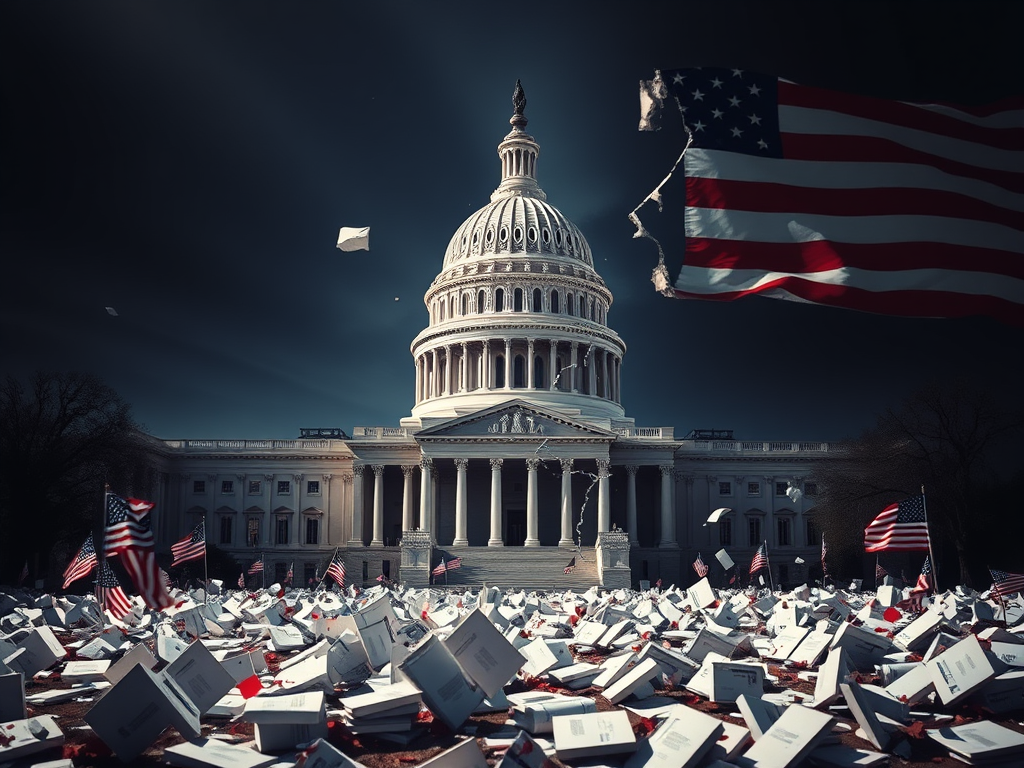
The American democratic system is detrimental to its citizens. Democracy, while often held as one of the most heralded portrayals of American culture, has continuously produced results that are counter productive for its majority. Instead, this deceptive system has exacerbated political polarization, increased the wealth gap, and perpetuated systemic racism. American citizens are suffering the brunt end of this hopelessly inefficient and unjust apparatus. Record high homelessness, rising prices on essentials, and an influx of illegal immigrants are just a few of the vast issues that are actively impacting the lives of everyday people that have yet to be addressed by the supposed juggernaut of the free world. These failures are made incongruous when compared to autocratic counterpart China who have been much more efficient in their measures to counteract such problems. The conditions that the majority of Americans are subject to are not due to a lack of resources; it’s the result of bureaucratic and structural issues in our governmental processes – the two party system, big money, and voter suppression.
The United States is the third largest country in the world with a diverse people, yet only two political parties are able to adequately represent the views of all citizens. The first United States President warned against straying away from a uniparty political system out of fear of division and an erosion of public trust. His premonitions are manifesting themselves in our current political climate. Marred by polarization and corruption, political apathy is continuing to grow at a steady rate. People are not satisfied with either party and are thus disengaging from politics altogether. Many of the nations with the highest levels of political trust often have multiparty systems like those seen in the Baltic region.
The purpose of a representative democracy like the one in the United States is to elect people to government that are representative of the interests of the people they are representing. However, the corrupting influence of big money in politics is undoubtable. Quite fitting for a capitalistic nation, money can essentially buy you power in our political system. Thus, to have a fighting chance to win a race, you need to have a lot of money. And as a result, you need to either be a wealthy individual, or bend to the interests of wealthy individuals. And when elected representatives are indebted to the donations of the wealthy, they are susceptible to serving the special interests of those who have and continue to financially support them: the wealthy. As a consequence, Congress is replete with members of the top 1% while the lower classes have virtually no representation. Moreover, pernicious industries like the pharmaceutical and fossil fuel industries invest billions of dollars in lobbying in order to gain Congressional support irrespective of what their constituents actually support.
While the power of the vote is ideally supposed to keep corrupt politicians out of positions of power, voter suppression efforts like gerrymandering and harsh voter ID laws have subdued the vote’s power. Every ten years, the political party that holds the majority in the state legislature is responsible for redistricting. Oftentimes, parties use factors like political affiliations and race to manipulate district boundaries to increase their representation in government. So, while a significant portion of a state’s population may vote for the opposing political party, their vote won’t have the same weight due to gerrymandering. While gerrymandering dilutes the power of the vote, the act of voting is made more unattainable for the masses due to strict voter ID laws. In an attempt to limit voter fraud – which is severely overstated – there have been a whole host of particularities one must possess or follow in order to vote. Many of these requirements make it difficult for low-income and minority voters to accurately register themselves to vote. In conjunction with gerrymandering, these practices act as significant barriers for people to hold elected officials accountable.
The practicality of the American government is on the brink of becoming untenable. In order to prevent the collapse of a system that rings so true in our nation’s founding, radical reforms are necessary. We need to instill electoral reform in order to amplify third party voices and eliminate gerrymandering. We need to reduce the impact of big money to make politics about the people once again. We need to strengthen our democracy through civic education and participation. But hey, it’s just a thought!
 Ode To Thought